The Mystery of the Ant Colony
Have you ever watched ants working together?
Thousands of tiny creatures can build bridges using their own bodies, construct elaborate underground cities, coordinate attacks, transport objects many times their weight, and solve complicated problems.
What makes this extraordinary is that there is no central commander.
The queen doesn't direct construction projects or organize military operations. Individual ants respond to their surroundings, communicate through chemical signals, and follow relatively simple behavioral rules.
Yet collectively, they accomplish things that no individual ant could ever achieve alone.
Scientists call this phenomenon collective intelligence.
And it raises a fascinating question:
Could humanity be doing something similar, without even realizing it?
Could each of us be contributing to a much larger intelligence—or perhaps even a shared consciousness—that exists beyond our individual awareness?
The Intelligence That Emerges Between Us
Imagine a single neuron in your brain.
That neuron cannot write a poem, experience love, solve a mathematical equation, or contemplate the universe.
Yet billions of neurons communicating through electrical and chemical signals collectively support the extraordinary capabilities of the human mind.
The intelligence of the brain is not contained within any single neuron. It arises from the organization and interaction of an enormous network.
Now consider humanity.
There are billions of people on Earth, each possessing individual thoughts, memories, emotions, experiences, and intentions.
We communicate constantly. We exchange information, influence one another, develop shared beliefs, create technologies, and build civilizations.
No single person understands everything humanity is doing.
Yet together, we have developed languages, cities, global communication networks, scientific knowledge, and technologies that no individual could create alone.
Just as ants collectively build structures they cannot individually comprehend, humanity creates systems far beyond the understanding of any one person.
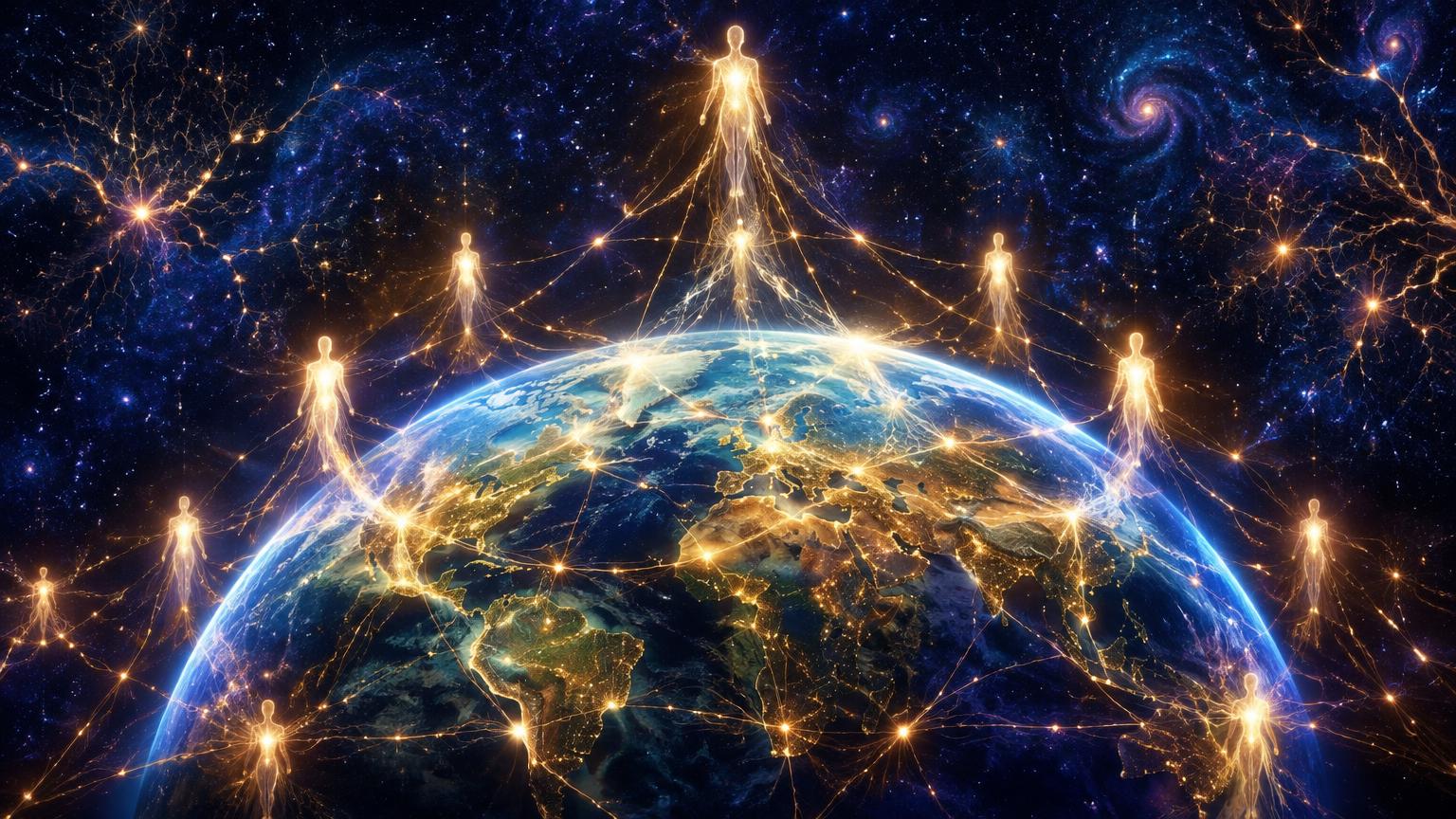
What if we are not merely individuals living alongside one another, but interconnected participants in a much larger system of intelligence?
The Science of Collective Intelligence
Collective intelligence is not simply a spiritual concept. It is an established area of scientific research.
Researchers have documented sophisticated group behavior in ants, honeybees, birds, fish, and other social organisms.
Honeybees, for example, can collectively select a new home. Scout bees investigate potential nesting locations and communicate their findings through specialized dances. Through recruitment, competition, and quorum-based responses, the swarm can converge on a decision.
No single bee needs to understand the entire process.
Schools of fish can rapidly change direction while maintaining remarkable coordination. Birds form spectacular murmurations, moving in patterns that appear almost choreographed.
These behaviors emerge through interactions among individuals responding to local information.
Scientists call this process emergence: the appearance of complex, system-level properties through interactions among simpler components.
Emergence demonstrates something profound.
A system can develop capabilities that are not present in any of its individual parts.
But there is an important distinction: collective intelligence does not necessarily mean collective consciousness.
A colony may process information and make adaptive decisions without having a single, unified subjective experience.
Whether consciousness itself can emerge at the level of an entire group remains an open philosophical and scientific question.
Are Humans Part of a Larger Living System?
Consider the human body.
Trillions of cells cooperate to maintain a functioning organism.
Different cells perform different roles. Some transmit information, others provide protection, transport nutrients, or repair damaged tissues.
Most cells have no awareness of the complete organism they help sustain.
Yet their coordinated activity makes our existence possible.
Now imagine looking at humanity from a much greater perspective.
Our transportation networks resemble circulatory systems, moving people and resources across the planet.
Our communication networks resemble information-processing pathways.
Our cities function as interconnected centers of activity.
Our scientific and cultural institutions preserve and transmit accumulated knowledge.
Humanity increasingly behaves like a globally interconnected system.
This doesn't mean the Earth literally possesses a humanlike brain or that humanity has been proven to be a conscious superorganism.
But the similarities invite us to consider whether intelligence can exist at multiple levels of organization.
Could an individual human be to humanity what a neuron is to the brain?
And if so, could something emerge from our collective interactions that we cannot perceive from our individual perspectives?
The Possibility of a Shared Consciousness Field
This is where the discussion moves beyond established collective intelligence research and into the fascinating territory of metaphysical inquiry.
What if consciousness is not entirely produced by the brain?
What if consciousness is, at least in part, a fundamental aspect of reality?
Some philosophical and scientific hypotheses explore whether consciousness might be more fundamental than our conventional understanding of matter and biological activity suggests.
Other approaches investigate whether consciousness emerges from particular forms of integrated information processing.
These perspectives are not equivalent, and none currently establishes the existence of a universal consciousness field.
But consider a possibility.
Suppose individual brains do not merely generate conscious experience independently. Suppose they also interact with a deeper aspect of reality associated with consciousness.
In such a model, our individual awareness might represent localized expressions of something more extensive.
We would experience ourselves as separate individuals while potentially participating in a larger interconnected system.
This idea resonates with spiritual traditions that describe universal consciousness, oneness, or an underlying unity connecting all living things.
It also raises questions that can be explored through neuroscience, philosophy, physics, and carefully designed experiments.
However, a shared consciousness field remains a hypothesis, not an established scientific discovery.
Could Love and Compassion Strengthen Our Connections?
If humanity is interconnected, what role might love play?
We already know that human emotions and behaviors influence others.
Compassion can inspire compassion. Fear can spread through communities. Acts of kindness can encourage additional acts of kindness.
Psychologists and social scientists study how emotional states, social norms, and behaviors propagate through interpersonal networks.
These effects do not require an invisible consciousness field. They can occur through ordinary communication, observation, relationships, and shared experiences.
Nevertheless, they reveal how profoundly our individual choices can affect a larger human system.
When we help another person feel valued, safe, and connected, the benefits may extend beyond that individual.
When we practice forgiveness, compassion, and understanding, we may interrupt cycles of hostility and encourage healthier relationships.
This is one reason the Metaphysical Learning Center emphasizes personal growth, love, and raising our vibration.
In spiritual language, raising our vibration can represent cultivating greater love, emotional balance, compassion, and awareness.
Although this spiritual use of frequency is not the same as a measurable physical frequency, it provides a meaningful way to describe the quality of our inner lives and relationships.
Perhaps one of the most powerful ways to contribute to humanity's collective well-being is to improve the quality of consciousness we bring into our interactions.
The Internet, Artificial Intelligence, and an Emerging Global Mind
For thousands of years, humanity's ability to share knowledge was constrained by geography, language, and communication technology.
Today, billions of people are connected through digital networks.
Ideas can travel around the planet almost instantly.
Scientific discoveries can be shared globally.
Artificial intelligence can analyze enormous collections of information, identify patterns, and help people solve problems across disciplines.
These technologies are dramatically expanding our capacity for collective information processing.
Some thinkers have explored the idea of a global brain: a planetary network of humans, technologies, and institutions that collectively gathers, processes, and applies information.
This does not establish that the network is conscious.
But it raises a compelling possibility.
Could humanity be developing increasingly sophisticated forms of collective intelligence?
And could these systems eventually exhibit properties that are difficult to understand by examining their individual components?
There is also a cautionary lesson.
Greater connectivity does not automatically create greater wisdom.
Misinformation, manipulation, polarization, and groupthink can spread through networks just as cooperation and knowledge can.
The quality of our collective intelligence depends not only on how connected we are, but on how thoughtfully we communicate and collaborate.
Ancient Wisdom and the Idea of Oneness
Long before scientists began studying collective intelligence, spiritual traditions explored the possibility that apparent separation is not the ultimate nature of reality.
Certain interpretations of Hindu philosophy describe an underlying unity of existence.
Buddhist teachings emphasize interdependence and the ways phenomena arise through relationships and conditions.
Many Indigenous traditions express profound relationships among people, nature, ancestors, and the living world, although their teachings are diverse and should not be reduced to a single philosophy.
Mystical traditions across cultures have described experiences of unity, interconnectedness, and the dissolution of boundaries between self and other.
These perspectives are not scientific proof of a shared consciousness field.
But they demonstrate that human beings have contemplated interconnected existence for thousands of years.
Modern research into collective behavior provides a different way of examining how individual components participate in larger systems.
Perhaps the most productive approach is not to assume that ancient spirituality and modern science are saying exactly the same thing, but to explore where their questions overlap.
What If We Are the Ants?
Return for a moment to the ant colony.
Imagine that an individual ant could suddenly become aware of the entire colony.
It might discover that its seemingly small actions contribute to a vast network of coordinated activity.
It might recognize patterns and structures that were previously invisible from its limited perspective.
Now imagine humanity experiencing a similar shift in awareness.
What if we could perceive the full consequences of our thoughts, choices, relationships, and collective actions?
What if we recognized that our individual lives influence countless others through networks of connection extending across generations?
We don't need to prove the existence of a universal mind to recognize the importance of that possibility.
Our actions already ripple outward.
The knowledge we share becomes part of humanity's accumulated understanding.
The love we express can influence families and communities.
The decisions we make help shape the world that future generations inherit.
In this very real sense, we are participants in something much larger than ourselves.
Could Humanity Eventually Become Collectively Conscious?
This remains one of the most intriguing unanswered questions.
We know that individual humans possess conscious experience.
We know that groups of humans can demonstrate collective intelligence.
But does sufficiently sophisticated collective intelligence eventually produce a new level of subjective awareness?
There is currently no established scientific method that demonstrates humanity possesses a single, unified conscious experience.
And we should not assume that simply connecting conscious individuals creates another conscious entity.
Yet the broader scientific question is worth investigating.
What organizational properties are necessary for consciousness?
Does consciousness require particular kinds of information integration, feedback, embodiment, or biological processes?
Could those properties exist in systems radically different from the human brain?
And how could researchers distinguish genuine consciousness from behavior that merely appears intelligent?
These are questions at the intersection of consciousness science, artificial intelligence, complexity theory, and philosophy.
A Different Way to See Ourselves
Perhaps the most meaningful lesson from collective intelligence is that individuality and interconnectedness are not opposites.
An ant remains an individual organism while participating in a colony.
A neuron performs its own functions while contributing to the brain.
A human being possesses an individual life, identity, and perspective while participating in families, communities, cultures, and humanity as a whole.
We can be individuals and interconnected at the same time.
And perhaps recognizing that interconnectedness can change how we treat one another.
If our actions influence the larger human system, then compassion is more than a personal virtue.
Cooperation becomes more than a practical strategy.
Love becomes more than an individual emotion.
They become ways of strengthening the relationships through which humanity grows, learns, and thrives.
Whether or not a literal shared consciousness exists, our interconnectedness is already a profound reality.
Final Thoughts: Are We Separate, or Part of Something Greater?
We began with a simple observation: ants can accomplish extraordinary things together without a central commander.
From there, we explored the possibility that humanity may also participate in forms of collective intelligence far greater than any individual mind.
Science confirms that collective intelligence exists.
It demonstrates that complex systems can develop sophisticated capabilities through decentralized interactions.
What science has not established is whether humanity possesses a unified collective consciousness or whether our individual minds connect through a universal consciousness field.
Those remain possibilities to investigate, not conclusions to accept without evidence.
But perhaps the most important insight is already within our reach.
We are not as separate as we sometimes imagine.
Every conversation, every act of kindness, every discovery, and every expression of love contributes to the human world we collectively create.
And if we are participating in something greater than ourselves, perhaps our greatest responsibility is to become more conscious of what we contribute.
Because whether we are individual minds building a collective intelligence or expressions of a deeper shared consciousness, one principle remains powerful:
When we elevate ourselves through love, compassion, and understanding, we create the possibility of elevating others.
And perhaps that is how humanity begins to rise together.
A Question for You
Do you believe humanity is gradually creating a greater collective intelligence through our connections, or could we already be connected through a shared consciousness that we have yet to understand?
We'd love to hear your thoughts.
At the Metaphysical Learning Center, we explore consciousness, intuition, spirituality, and personal transformation with open minds, curiosity, and a commitment to meaningful discovery.
Explore more at metaphysicallearning.com, or start with our free guide, 7 Signs Your Intuition Is Awakening.
Go deeper with a course
Courses at the Metaphysical Learning Center that build on this topic:
Browse all coursesRelated articles
- What If Your Body Was Designed to Be the Perfect Interface for Your Soul?
Your body is a living electrochemical system. What if it doesn't create consciousness — but lets your soul experience physical reality?
- Psychic vs Medium vs Tarot Reader: Types of Metaphysical Practitioners Explained
Psychic vs medium: what's the difference? A clear guide to psychics, psychic mediums, tarot readers, energy healers and other metaphysical practitioners.
- 111 Meaning: New Beginnings, Intuition, and Alignment
Explore 111 meaning through spiritual traditions, intuition, and everyday reflection, with grounded exercises to help you interpret this repeating number.